

Ram Bhakts Walking to Ayodhya: Stories of Faith from the Ramtek Highway
Some travel encounters are planned. Others happen unexpectedly and stay with you long after the journey ends.
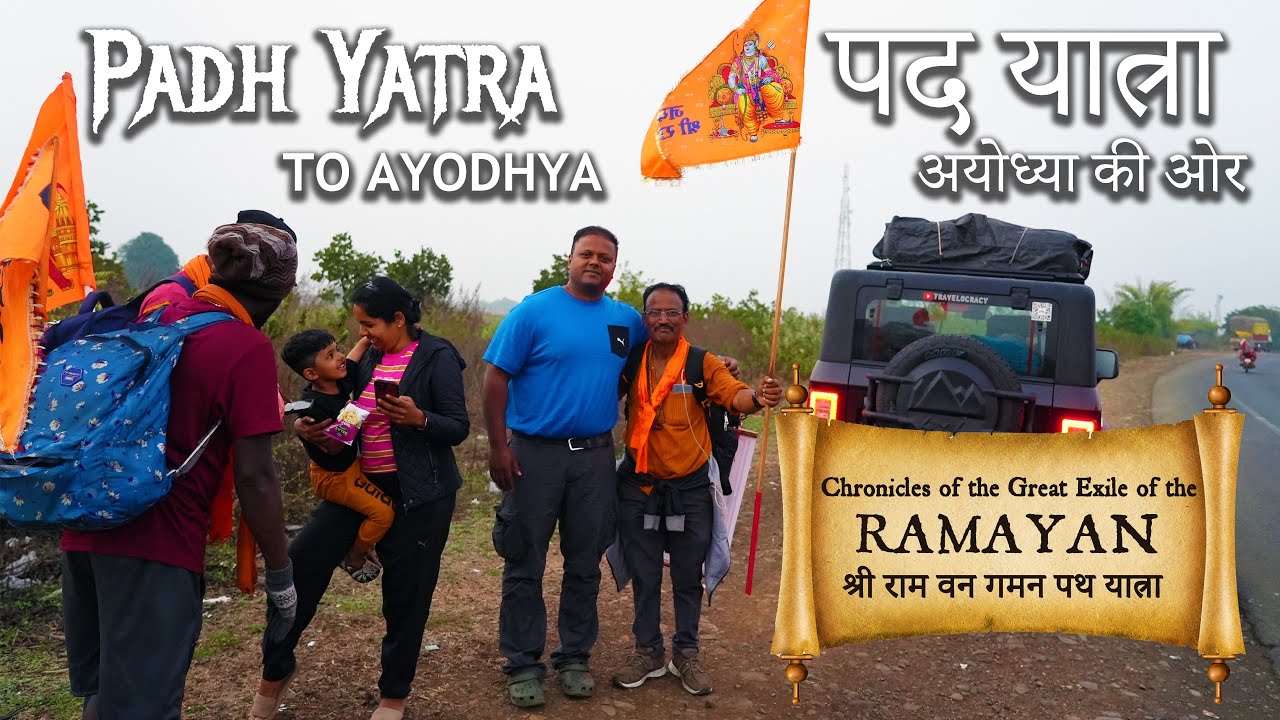
While travelling from Ayodhya toward Sri Lanka as part of our Ram Van Gaman Path journey, we met a group of Ram Bhakts on the Ramtek Highway. They were not travelling by car, bus or train.
They were walking to Ayodhya.
Some had already spent several weeks on the road. Their feet were covered with blisters, their belongings were limited, and the destination was still hundreds of kilometres away. Yet there was no uncertainty in their voices.
They wanted to reach Ayodhya and witness the historic Pran Pratishtha of Ram Lalla on January 22, 2024.
Their stories transformed an ordinary highway stop into one of the most memorable moments of our journey.
Watch the complete encounter below:
Walking Hundreds of Kilometres to Ayodhya
Among the devotees we met were two pilgrims travelling from Karnataka. They told us that they had already been walking for approximately 25 days and had covered nearly 900 kilometres.
They had begun their padayatra with a resolution to complete the journey barefoot.
But walking continuously on highways had taken a serious toll. Their feet had developed painful blisters, forcing them to wear slippers temporarily so that they could continue moving.
Their physical condition was becoming increasingly difficult, but their commitment remained unchanged.
There were still several days of walking ahead of them. Each morning meant returning to the road, carrying their belongings and continuing toward a destination that existed not only on the map but also in their hearts.
For them, reaching Ayodhya was not an ordinary travel goal. It was the fulfilment of a deeply personal spiritual desire.
When the Body Becomes Tired but Faith Continues
A long-distance padayatra is often described as a devotional journey. On the road, however, its physical reality becomes impossible to ignore.
The pilgrims had to endure:
- Painful blisters and swollen feet
- Changing weather conditions
- Uncertainty about food and accommodation
- Long stretches of highway traffic
- Physical exhaustion accumulated over several weeks
Despite these challenges, they continued walking.
Their journey demonstrated something simple but powerful: faith does not remove hardship. It gives people a reason to continue through it.
Every blister, every difficult kilometre and every night spent away from home became part of their offering.
A Failed Journey to Vrindavan That Led to Ayodhya
One pilgrim shared a particularly moving account of how his journey to Ayodhya began.
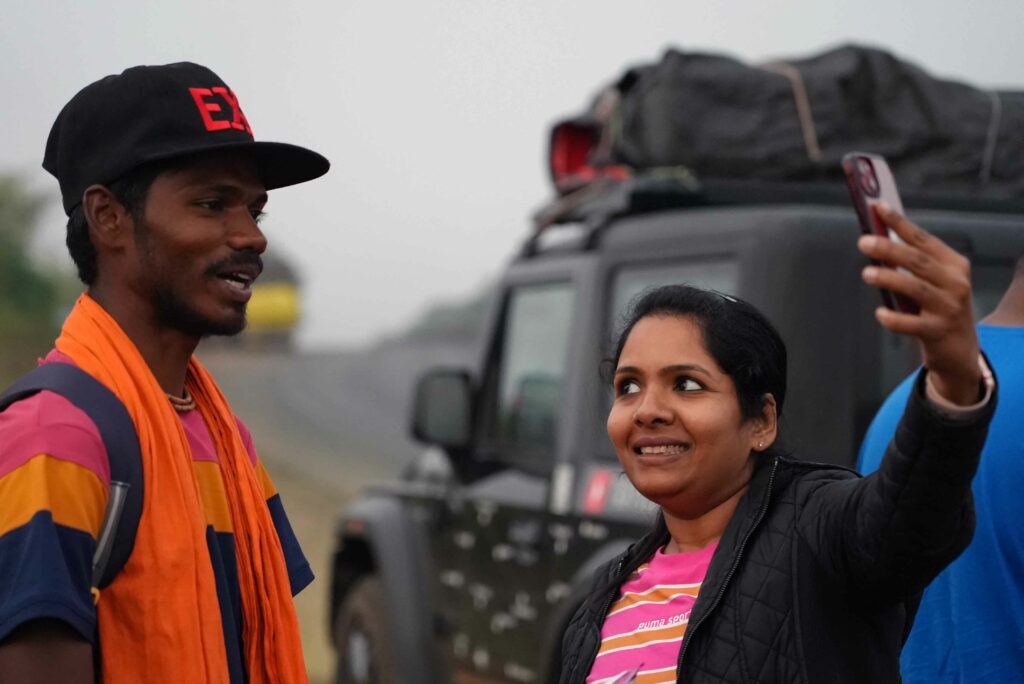
His original wish was to visit Vrindavan. For nearly a month, he repeatedly tried to obtain a train ticket. He checked online and attempted Tatkal bookings several times, but every attempt failed.
He could not understand why he was unable to travel to the place he had been longing to visit.
One night, overwhelmed by disappointment, he began to cry. He wondered whether he had committed some mistake that prevented him from receiving Radha Rani’s call to Vrindavan.
Later that night, while listening to a spiritual discourse on his phone, he heard about the upcoming Pran Pratishtha in Ayodhya.
That moment changed his understanding of everything that had happened.
Perhaps, he thought, the doors to Vrindavan had not been closed as a rejection. Perhaps he was being redirected toward Ayodhya.
By approximately 4:00 in the morning, he had made his decision. He packed his belongings and started walking.
A failed railway booking had become the beginning of a journey of nearly a thousand kilometres.
Meeting a Kar Sevak Who Remembered 1990
We also met a pilgrim who introduced himself as Dhananjay Patse, originally from Jabalpur and presently working in Nagpur.
He told us that this was his third major padayatra.
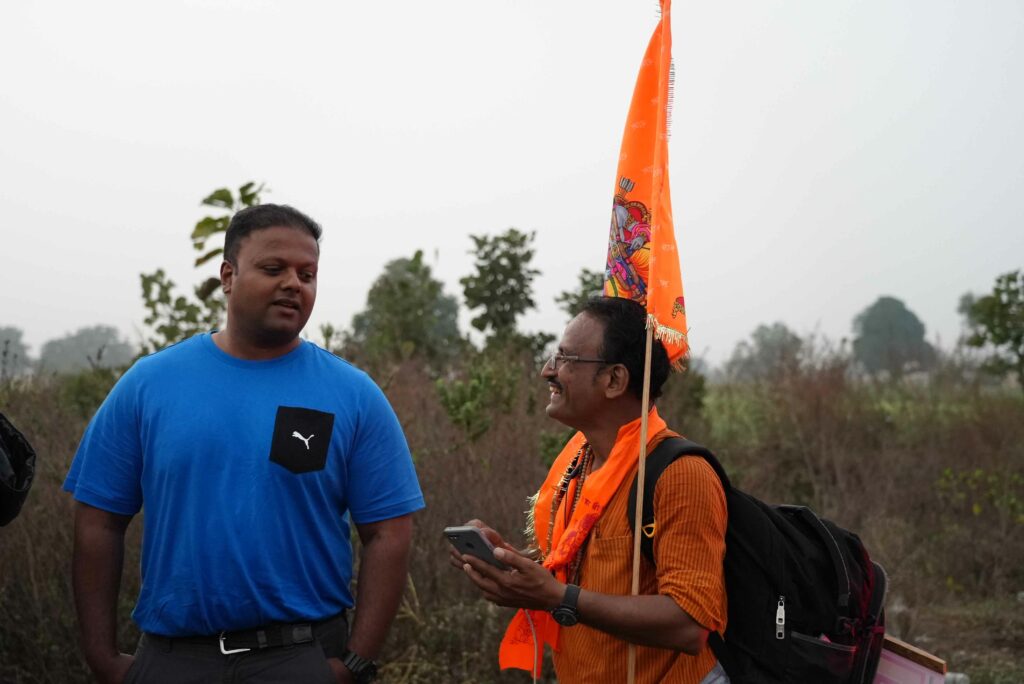
However, his connection with Ayodhya went much further back than this journey. He said that he had participated in Kar Seva during the Ram Janmabhoomi movement in 1990.
According to his recollection, he was arrested and imprisoned under the Uttar Pradesh government of that period.
The events of 1990 remain an important and sensitive chapter in the history of the movement. On October 30 and November 2, 1990, police action was taken against Kar Sevaks attempting to reach the disputed site in Ayodhya. Former Uttar Pradesh Chief Minister Mulayam Singh Yadav later publicly defended the decision while also acknowledging the loss of life.
For Dhananjay, however, history was not something available only in books, political speeches or television archives. It was part of his own memory.
More than three decades later, he was once again travelling toward Ayodhya—this time to witness the consecration of Ram Lalla in the newly constructed temple.
From the Memories of 1990 to the Moment of 2024
Dhananjay also remembered the political change that followed the events of 1990.
Kalyan Singh became Chief Minister of Uttar Pradesh on June 24, 1991. For many people associated with the Ram Janmabhoomi movement, that change represented a new phase in their long campaign.
Dhananjay spoke with the perspective of someone who believed he had witnessed two very different periods: one in which he says he was imprisoned for participating in Kar Seva, and another in which the construction and consecration of the temple had become a national event.
For him, the journey toward Ayodhya was therefore more than a pilgrimage.
It was the completion of a personal circle extending across 34 years.
The January 22, 2024 Pran Pratishtha
The Pran Pratishtha of Ram Lalla took place at the newly constructed Shri Ram Janmabhoomi Mandir in Ayodhya on January 22, 2024.
For devotees travelling on foot, the ceremony carried a meaning that went far beyond the architecture of the temple.
Many viewed it as the culmination of generations of prayer, campaigning, sacrifice and waiting. Some had participated directly in the movement. Others had inherited its memories from parents, grandparents and members of their local communities.
The pilgrims we encountered wanted to be present not merely as visitors but as witnesses to a moment they believed would be remembered for generations.
How Strangers Support Pilgrims on the Highway
A journey of this scale cannot be completed through physical determination alone.
The pilgrims depended on the kindness of people they met along the way. Someone might offer food, another person might provide a place to rest, and a shopkeeper might help them with water, medicine or a pair of slippers.
The travellers described these encounters in spiritual terms.
When assistance appeared at the moment it was most needed, they felt that Lord Ram himself had arrived through the kindness of a stranger.
This informal network of support is one of the most beautiful parts of a padayatra. There is no central office coordinating every meal or night’s accommodation. Instead, ordinary people become part of the pilgrimage by helping those walking toward their destination.
The pilgrim walks, but the entire road participates.
The Highway as a Place of Living Faith
Temples are normally associated with sanctums, bells, lamps and rituals.
But during this encounter, the highway itself seemed to become a place of worship.
There were no decorated gates or organised queues. There was only the endless road, the sound of passing vehicles and the steady movement of pilgrims travelling north.
Their prayers were expressed through their footsteps.
Their physical discomfort became part of their devotion. Every person who stopped to assist them became part of the journey.
The experience reminded us that some of the most meaningful spiritual stories are not always found at famous destinations. They may be found on the road, far away from ceremonies and crowds.
Why These Stories Must Be Preserved
Major historical events are usually remembered through court judgments, political speeches, monuments and official ceremonies.
But history also survives through personal memories.
It survives in the story of someone who says he was imprisoned as a Kar Sevak in 1990 and returned toward Ayodhya more than three decades later.
It survives in the determination of pilgrims who continued walking despite painful blisters.
It survives in the experience of a devotee who could not obtain a train ticket to Vrindavan but interpreted that disappointment as a call to walk toward Ayodhya.
These stories may never appear in conventional history books. Yet they reveal how major events are experienced by ordinary people.
A Journey We Will Always Remember
Our meeting with these Ram Bhakts was brief, but their stories left a lasting impression.
They had no elaborate travel arrangements. They did not know exactly where they would eat or sleep each day. Their bodies were tired, and the road ahead remained long.
But their purpose was clear.
They continued walking because reaching Ayodhya meant something deeply personal to each of them.
Long after the completion of the Pran Pratishtha ceremony, the image that remains with us is not only that of the grand temple. It is also the image of ordinary devotees walking along an Indian highway with blistered feet and extraordinary faith.
Their journeys remind us that a destination is sometimes built not only through stone and architecture but also through sacrifice, memory and countless determined footsteps.
Watch the complete video and listen to the pilgrims share their stories in their own words.
Jai Shri Ram.
Frequently Asked Questions
Who are the Ram Bhakts featured in the video?
The video features pilgrims encountered by Travelocracy on the Ramtek Highway. Some were walking from Karnataka toward Ayodhya, while another pilgrim, Dhananjay Patse, said that he was travelling from the Nagpur region and had participated in Kar Seva in 1990.
How long had the pilgrims been walking?
Two of the pilgrims said that they had been walking for approximately 25 days and had covered close to 900 kilometres when they were interviewed.
Why were they walking to Ayodhya?
They wanted to reach Ayodhya to witness the Pran Pratishtha of Ram Lalla at the Shri Ram Janmabhoomi Mandir on January 22, 2024.
Who is Dhananjay Patse?
In the video, Dhananjay introduces himself as a native of Jabalpur who was working in Nagpur. He says he participated in Kar Seva in 1990, was imprisoned during that period and later undertook a padayatra toward Ayodhya ahead of the 2024 consecration.
What is a padayatra?
A padayatra is a journey undertaken on foot. It may be organised for spiritual, social or political purposes. In a religious context, walking itself becomes part of the pilgrim’s devotion and discipline.
When did the Ram Mandir Pran Pratishtha take place?
The Pran Pratishtha of Ram Lalla in the newly constructed Ram Mandir in Ayodhya took place on January 22, 2024.
Where was this Travelocracy video recorded?
The encounter was recorded on the Ramtek Highway while the Travelocracy team was travelling from Ayodhya toward Sri Lanka as part of the Ram Van Gaman Path journey.